
- HOME
- Survival Skills
- Emergency First Aid Skills
How Good Are Your
First Aid Skills in an Emergency?

Because we are used to being able to see a doctor at any time for any reason, emergency first aid information will be extremely important in the event of a disaster.
There are many scenarios in which access to medical care may be restricted or non-existent. Would you know what to do if you were on your own for a few days—or a few weeks?
Any major disaster such as a blizzard, earthquake, flood, terrorist attack, or a sustained power outage would interrupt the usual medical care.
Invest in emergency food storage now and enjoy peace of mind for the next 25 years. Don't miss out on the savings!
The information on this website is not a substitute for seeking necessary medical care when it is available, but is intended to help you plan and prepare to take care of the medical needs of your family and others during a crisis.
Are you prepared for doing things that are not in your normal day-to-day life, even if you or someone else is injured?
NEVER ASSUME . . .
. . . that help will arrive in a crisis. Know first aid and have a family first aid kit and medicines available before disaster strikes.
Can you?
- lift sandbags
- cut wood
- work in the dark
- cook over an open fire
- manage sanitation problems and contaminated water
Educate Yourself
Before a disaster strikes, educate yourself in emergency first aid and medical care. Classes may be available through your community adult education or the American Red Cross. There are many books available that cover a wide variety of injuries and illnesses.
Make sure you have a good first aid kit and a stock of medicines that you might need. You should keep a first aid kit in every car and a larger one at home for your family.
YOU WILL NEED:
(click on the links for more info)
Be sure to include soap to wash hands as sanitation is even more important in a disaster than other times to avoid diseases. The healthier you are when a disaster or survival situation strikes, the greater the chance that you will survive. Exercise regularly, eat well, have preventative medical and dental care, and be happy.
Managing Common Injuries
Lacerations/Bleeding
Cuts (lacerations) are one of the most common injuries and can be caused by knives, broken glass, scissors, or falls. Deep cuts can damage blood vessels and nerves.
The first step in treating a cut is to stop the bleeding. While wearing a disposable latex or nitrile glove, place several sterile gauze pads over the cut and apply pressure directly over the wound for at least five minutes. Most bleeding can be stopped this way. Sometimes pressure may need to be held for up to 30 minutes. Nasal sprays that contain blood vessel constrictors, such as Neo Synephrine or Afrin, can help stop minor bleeding. Moisten a sterile gauze pad with the spray and pack it into the wound for five minutes before removing.


Your emergency first aid kit
should include
materials
to treat lacerations and
bleeding, including
sterile
gauze pads, pressure
dressings,
rolled gauze
bandages,
wound closure
strips,
antibiotic ointment,
and Band-Aids.
After the bleeding has stopped, clean the wound to remove bacteria, dirt, blood clot, and damaged tissue. Use a 10 to 15-ml syringe filled with water to rinse the wound. This works like a high-pressure squirt gun to clean the wound of debris. Inspect the wound to make sure all particles of dirt or dried blood are gone, as they will be a source of infection.
Some wounds need to be stitched (sutured) by a doctor to help the healing process, improve the appearance of scars, and reduce the chance of infection. A general rule of thumb is to stitch any wound over an inch long or one where the edges of the skin do not fall together. Any wounds that show bone or muscle, are large or deep, involve joints, hands, or feet, or that could leave conspicuous scars, such as those on the face, should be seen by a doctor.
If wounds do not need to be stitched or if medical care is not available, they can be closed with wound closure tape strips, such as Steri-Strips, or butterfly bandages. Apply a thin layer of tincture of benzoin to the skin on each side of the wound and let it dry for 30 seconds.
Apply the tape to the skin on one side of the cut, gently pull the wound closed so the skin edges just touch, and attach the tape to the skin on the other side. The tape should extend about one inch on each side of the wound. Apply more strips of tape about ¼ inch apart until the entire wound is closed.
After closing the wound, place a non-adherent dressing, such as Telfa or Adaptic, over the wound to keep it clean, followed by an absorbent gauze, and, finally, an elastic bandage or rolled gauze bandage to keep the dressings in place. Check the wound daily for infection, which will present as increased pain, redness, swelling, pus, or greenish drainage from the wound. If infection develops, seek medical care since antibiotics may be necessary.
Strains, Sprains, and Fractures
Injuries to the bones, muscles, and joints are common.
- Sprains are stretching or tearing of ligaments that attach bones together.
- Strains are tearing or stretching of muscles or their tendons that attach them to bones.
The ankle and knee are the joints most often sprained. Muscle strains from overexertion or lifting are common, with back strains being particularly disabling.
Pain or tenderness at the site, swelling, bruising, and pain on movement of the injured area are signs of a strain or sprain. These are also present with a fractured bone and it may be difficult to distinguish between fractures and strains or sprains.
Standard treatment for any sprain or athletic injury is summarized by the acronym RICE—rest, ice, compression, and elevation. Take the stress off the injured area by resting to prevent further damage to the ligaments or muscles. Apply ice early to reduce the swelling and pain. It should be used for up to 20 minutes 3 to 4 times per day. Swelling will return once the ice is removed unless a compression wrap is used. Place padding, such as gauze or socks, over a sprained joint and wrap with an elastic bandage. It should be comfortably tight and loosened if there is increased pain, numbness, or tingling. Elevate the injured area to reduce swelling. Continue the RICE treatment for the first 72 hours. After that, tape or splint the injured area to stabilize it and prevent further injury.
Treating the Pain - Non-steroidal anti-inflammatory medications, such as ibuprofen (Motrin) 600 mg. three times a day with food, can be taken to reduce both inflammation and pain.
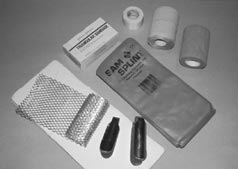
For sprains and fractures,
splinting materials should be
part of your emergency first aid kit.
Shown here are a SAM splint,
wire splint, foam-board splint,
finger splints, triangular bandage,
elastic bandages, and adhesive tape.
Fractures
Bone fractures are characterized by pain, swelling, bruising, deformity, the inability to put weight on or use the injured part normally, or the grating sound of bones rubbing against each other.
The injured person may have heard a snapping or popping sound at the time of the injury.
Sometimes it can be difficult to tell the difference between a fracture and sprain without an x-ray. All known or suspected fractures require medical evaluation.
Unstable or displaced fractures should be stabilized with a splint by emergency medical personnel or, if not available, by first aid methods before transport to a doctor hospital.
Back injuries
Muscle strains from overexertion or lifting heavy objects are the most common cause of acute back pain. Pain can be mild or so severe that the injured person is unable to sit or stand. Generally, the pain is worsened by bending, moving, or touching the area and made better by lying flat with the knees bent or supported by a pillow.
Bed rest is the initial treatment. Have the injured person lie on their back with a pillow under the knees, or on their side with a pillow between their legs for 1 to 2 days, while taking anti-inflammatory medications such as ibuprofen 600 mg three times a day with meals. Ice packs will reduce swelling and decrease pain.
After two days, resume gentle activity as longer bed rest can slow recovery. Most people with back strains recover on their own in 2 to 4 weeks.
Ruptured (herniated) disks are ruptures of the cartilage discs in between the vertebrae of the back. Heavy lifting can cause discs to rupture and put pressure on the spinal nerves causing pain which can radiate down the buttock and leg (sciatica). The pain is worse with sitting, bending forward, coughing, and lifting the leg. Numbness or tingling of the leg may occur. Treatment is initially the same as a back strain, however the injured person should seek medical care.
Severe back pain that is not made worse with movement or change of position can be a sign of a serious abdominal problem, including a kidney stone or kidney infection. Seek medical care.
Burns
Burns can be caused by heat, flames, chemicals, or by electricity. The severity of the burn depends on the temperature of the heat source, the length of time of exposure, the size of the burn, and the location on the body. First-degree burns, such as minor sunburns, injure the first layer of skin and cause redness and pain. Second-degree burns injure deeper layers of skin, causing blisters. Third-degree burns destroy the skin and burn into deeper tissue layers or muscle and are very serious. They can look charred, black, or brown and may be painless if nerve endings have been burned. When burns damage the integrity of the skin, the body loses fluid and is susceptible to infection.
The first thing to do to care for burns is to stop the burning.
- Put out flames on clothing.
- Cool the burned area with large amounts of cool water for several minutes.
- Cover the burned area with dry, sterile dressings to help prevent infection.
- Don’t apply any type of ointment or burn cream as it seals in heat and does little to reduce pain.
- Blisters should be left unbroken to prevent infection.
Critical Burns
Critical burns require immediate medical care. An ambulance should be called for burns that are large, involve breathing difficulty, are on the head, neck, feet, or genitals, cover more than one part of the body, or result from chemicals, explosions, or electricity.
- Stop the burning
- Cover the burned area to prevent infection
- Keep the victim from becoming chilled while you wait for the ambulance.
Managing common illnesses
Diarrhea
Diarrhea is frequent (more than three a day) loose stools that can be caused from viral illnesses, bacteria from bad water or food, parasites from bad water, food allergies, inflammatory bowel disease, and anxiety. Abdominal cramps, nausea, vomiting, fever, and fatigue may also be present.
No treatment may be necessary if it lasts only 1 to 2 days. Diarrhea may be serious if it lasts longer or if there are more than 10 bowel movements a day. In severe diarrhea, up to 25 quarts of water can be lost in a day, rapidly leading to dehydration.
For diarrhea lasting more than three days or when accompanied by blood or mucus in the stool, fever greater than 101°F, severe abdominal pain or distension, or dehydration, the victim needs medical care for intravenous fluids and treatment of the underlying cause.
If these are not present, treat diarrhea by rehydrating the victim with water and electrolytes to replace lost salts, potassium, and bicarbonate. Oral rehydration salts containing the proper electrolytes are available commercially. Anti-diarrheal medications, such as Imodium, can reduce cramping and fluid loss. Imodium has fewer potential side effects than Lomotil. Pepto-Bismol and Kaopectate can also be used, but are less effective.
Dehydration
Dehydration is water loss greater than the amount the body needs to maintain its balance. It occurs when lost water is not adequately replaced and it decreases the ability of doing even the simplest of activities. Dehydration will also increase the chance of severe shock if an individual is injured.
Normally, the body needs 2 to 3 quarts of water a day to maintain normal balance. Sweating from heat, exercise, or work increases the amount of water loss dramatically. In conditions of heavy activity, 5 to 6 quarts (1½ gallons) or more can be needed per day.
By the time an individual is thirsty, they are already dehydrated. A 5% loss of body water, only 2.5 quarts for a 150-pound person, will cause thirst, irritability, nausea, and weakness. A 10% loss, 5 quarts for the same person, will result in headache, dizziness, inability to walk, and tingling sensations of the arms and legs. A swollen tongue, dim vision, numb sensations on the skin, and painful urination can occur with a 15% loss of water and any greater can cause death.
It is easy to forget to drink or to have inadequate water available during a crisis situation. Dehydration is largely preventable, so plan your daily water needs.
Treatment for dehydration is to replace the lost fluids. Replace fluids by drinking water, juice, lemonade, soup, decaffeinated coffee, Gatorade, or similar sports drinks.
Vomiting
Many things can cause vomiting, including food poisoning, stomach flu, viral illness, motion sickness, anxiety, pregnancy, and irritants to the stomach such as medications. Drink small amounts of clear liquid such as soup, tea, 7-Up, or diluted Gatorade. Be careful not to drink too much too soon, which will distend the stomach and cause more vomiting. Once vomiting has stopped, bland food such as toast or crackers may be started, progressing to a normal diet as tolerated.
Medical care should be sought for vomiting that is associated with head or abdominal injury, fatigue or confusion, severe abdominal pain or distention, fever over 101°F, fresh or dried blood in the vomit, or if it lasts over 24 hours. The source of the vomiting needs to be determined and prescription antiemetic (anti-vomiting) drugs are available.
Take Care of Yourself
Our ancestors had to depend on themselves to treat most of their medical problems. Despite our ready access to health care, we also may be faced with such situations. Be prepared by staying healthy and fit, learning first aid and CPR, having family medical books, a well-stocked first aid kit, and medicines available. Take the time now to prepare. Your life may depend on it.
Medications You May Need:
- Pain and Fever Medicines
- Anti-diarrheal - Imodium or Lomotil
- Anti-nausea - Pepto-Bismol, Mylanta
- Poisoning - Syrup of Ipecac
- Rash and itching - Benadryl tablets, Hydrocortisone cream
- Cough medicine
- Earache drops
- Eye drops
- Other over-the-counter medicines you use
- Prescription medications
Choose Your First Aid Kit:
You might like these
Household Disaster Kits - Why We Should Have One
Store bulky items inside a large, portable, watertight, household disaster kit.
Survival Medicine For Grid Down Survival
Survival medicine is about being prepared for a crisis with emergency first aid kits, knowledge of herbal medicines, foods that heal, and preventative health care.
Stock Your First Aid Kit For Emergencies
Emergency First-Aid Kit - What first aid supplies to include and first aid tips for emergencies and crises.


What do you think?
I’d love to hear what you have to say in the comments.






 Valley Food Storage



As an Amazon Associate, Family Survival Planning earns a small commission from qualifying purchases.
FTC DISCLOSURE
If you make a purchase via a link on this site,
I may receive a small commission on the
transaction, at no added cost to you.
Copyright ©2007 - 2021 FamilySurvivalPlanning.com. All rights reserved.
