
- HOME
- Preparing for Disasters
- Safe Room Storm Shelter
Do You Need a Safe Room
or Storm Shelter?
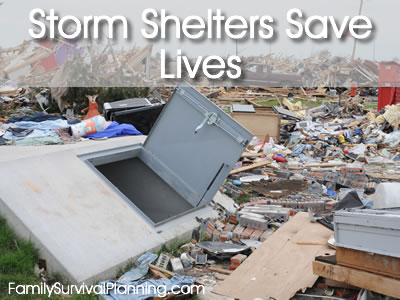 Storm Shelter in Oklahoma Tornado
Where is a good place for a safe room? How do I build one?
Do I need a storm shelter?
What should be stored there?
Your home is one of the safest places to be during a tornado or severe storms, but most homes aren't built to withstand sustained winds exceeding 90 miles per hour.
Invest in emergency food storage now and enjoy peace of mind for the next 25 years. Don't miss out on the savings!
5 Reasons You May Need a Safe Room/Storm Shelter
1. Tornadoes
If you live in an area where tornadoes occur frequently, you may want to consider building some kind of cement or underground shelter.
Tornadoes are powerful storms with extreme winds that few structures can withstand. A conventional residential home is not a lot of protection but can be reinforced to prevent at least your safe room from being blown over or crumbled by with wind or blowing debris.
Read more about how to prepare for and survive a tornado.

2. Hurricanes
Hurricanes are similar to tornadoes in that they produce extraordinarily powerful winds and wind-blown debris, and are more than capable of leveling conventional structures.
Unlike tornadoes, hurricanes also come with additional threats like flooding and storm surges. Hurricanes are also capable of spawning tornadoes.
Unlike tornadoes however, a safe room that is fit for surviving a hurricane should not be located below ground level for obvious reasons; they can just as easily turn into a watery tomb.
Read more about how to prepare and survive a hurricane.
3. Airborne Contamination
Airborne contamination could take the form of radioactive fallout, vapors from a chemical spill, a biowarfare attack or just copious amounts of smoke from a wildfire.
In any of those circumstances, the air is no longer safe to breathe. A properly equipped safe room will give you the ability to preserve your lungs when exposed to really bad air.
A full filtration and environmental/atmospheric system with air scrubbers, sensors, overpressure system and more will let you take it easy until the authorities sound the all clear.
There’s just one problem with this approach: it is fantastically expensive and beyond the reach of most preppers. But there is another way, one that will work for preppers on a budget, which we'll cover in a minute.

4. Earthquake
Surviving an earthquake not only depends on the structure of your home, but also the land on which it is built. Here in the Salt Lake Valley (Utah), which is considered "earthquake prone", there are areas that are safer than others.
For instance, the entire suburb of Sandy, Utah is built on, as its name implies, sand. If an earthquake hits, the sand will react like jello and the wobbling will shake most homes and buildings to the ground unless they are built specifically to withstand the movement (many are built with earthquake-resistant technologies).
Some areas of the valley have a base of deep rock. These are the safest areas to build. While damage will inevitably occur, a home or building may still be standing when it's all over.
A single room reinforced near the center of the home or in the basement would be the best place to build a safe room. However, the BEST course of action in an earthquake is to go outside away from buildings, trees, electrical lines or any other object that might fall.
In the home, careful attention to secure all overhead materials and falling debris one of the best things to do to preserve your possessions.
Read more about how to prepare for and survive an earthquake.
5. Terrorist Attack
A terrorist attack can take almost any form, from direct action assaults on civilians in a crowded event center with guns or bombs, to chemical or biological agent releases, to the deliberate setting of mass fires. No matter what kind of terrorist attack could break out near you, a safe room may save you and your family providing you can get there.
Any safe room equipped to deal with this circumstance will need to be modestly to heavily reinforced with armored walls and an especially strong door and hinges to resist forced entry.
Having access to TV, internet and radio inside to monitor the developing situation is a good idea, as is having medical supplies and weapons.
Choosing a Safe Room Area
One of our readers asked:
"How and what should one build in terms of a shelter if you live in the desert southwest. We do not have basements here only garages. What materials should we use to enclose or support a wall, what about windows?"
So let's address her question.
As we know, the purpose of a safe room or storm shelter is to provide a space where you and your household can seek refuge that provides a high level of protection.
These areas of your home would work for a safe room:
 This is a safe room built in a garage.
- In your basement
- Beneath a concrete slab-on-grade-foundation or garage floor
- In an interior room on the first floor. Shelters built below ground level provide the greatest protection, but a shelter built in a first-floor interior room can also provide the necessary protection. Below-ground shelters must be designed to avoid accumulating water during the heavy rains that often accompany severe windstorms.
To protect your family, a safe room within your home must be built to withstand high winds and flying debris, even if the rest of the residence is severely damaged or destroyed.
Important criteria for the space you choose:
- The shelter must be adequately anchored to resist overturning and uplift.
- The walls, ceiling, and door of the shelter must withstand wind pressure and resist penetration by wind-borne objects and falling debris.
- The connections between all parts of the shelter must be strong enough to resist the wind.
- If sections of either interior or exterior residence walls are used as walls of the shelter, they must be separated from the structure of the residence, so that damage to the residence will not cause damage to the shelter.

How To Create a Safe Room
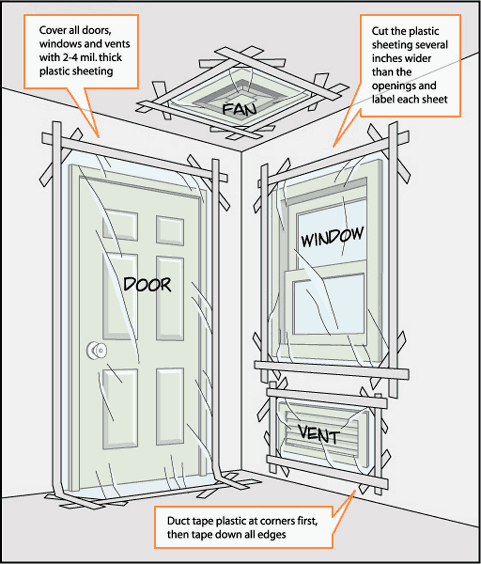
- Cover all doors, windows and vents with 2-4 mil. thick plastic sheeting.
- Cut the plastic sheeting several inches wider than the openings and label each sheet.
- Duct tape plastic at corners first, then tape down all edges.
Will you run out of oxygen?
Now that you've built your safe room and everything is sealed up tight, what about oxygen to breathe? Well, if there is a need to tape up all windows, doors, and vents, there is probably a chemical or biological reason to do so. Therefore, you do not want outside air coming into your safe room.
Knowing that you want to keep outside air from infiltrating your room, you will need to take into consideration how many people are going to be in that room and allow 10 square feet of space per person to provide enough oxygen for each person for approximately five hours. (Five hours is just a guide.)
When you will run out of air in the room depends on how big the room is, how many people (or pets) are in it, the lung condition or capacity of the occupants, and whether someone is prone to panic or hyperventilate in a crisis situation.
While confined in your safe room, make sure to take everyone's pulse every 10-15 minutes and write it down for each person. Even though your pulses will probably be a bit higher from stress or from rushing to get into the room and tape it up, what you're watching for is a sudden spike in anyone's pulse, especially after the 5-hour mark. That would signify that you're running out of air and would need to make a decision on whether it is safe to leave the room or not.
I hope you never have to make that decision but it may come down to breathing contaminated air or slowly be unable to stay awake and eventually pass out - and die.
A helpful item to have to prevent breathing contaminated air is a respirator mask. (This is an N95 respirator mask which filters airborne particles, available on Amazon. A P100 is much better as it also filters out drops of liquid.) These will protect your lungs from damage from breathing in particles in the air that might be left from a tornado or earthquake.
A respirator mask will not filter out viruses but will help contain the spread of disease if worn by the sick person.
Don't forget to pack your survival kit, protective gear, and other supplies to help dig out if necessary; and have some kind of shelter available in case the aftermath of a monster storm devastates your home.

10 Most Essential Survival Supplies to Keep in Your Safe Room
A safe room is not just a hardened structure to withstand direct assault. A safe room is also your armory and supply center. Your chosen room or shelter should be stocked with the types of survival gear to protect and sustain your family in any crisis.
- Communications – The most vital
prep to keep in your safe room is a way to summon the cavalry. Ideally this will be a self-contained communication item like a cell phone or radio, and not a landline.
- Water – You might be in your safe room for a long time depending on what you are facing, so a supply of bottled water is essential, especially if you have no running water.
- Food
– You are unlikely to need a large quantity of food while you're
waiting for a storm or crisis to subside, but some
basic calorie-dense snack options or even a few MREs are good options for keeping energy and morale levels high.
- First Aid Kit
– There
is always a chance that someone might be injured on the way to your safe room. Make sure you have the
things you need to deal with minor and major injuries and know how to
use them.
- Prescription Meds and Lenses – More
than a few of us may forget vital prescription medication and eyewear when hurrying to the safe room. Include these important supplies in your safe room packing
list.
- Weapons – Safe room or not, when you
are facing threats, human or nature, you may need weapons for dealing with two-legged
critters or four-legged critters in case your defenses fail. (Read more on choice of weapons and home protection.)
- Emergency Toilet
– Unless your safe room happens to be one of the bathrooms, you can
make everyone’s life a lot more pleasant if you have a simple emergency
toilet inside with all necessary disposal items. An inexpensive solution
could be a five gallon bucket with lid, heavy duty can liners, and some kitty litter to contain odors.
- Lighting
– Assume you’ll lose power while inside your safe room. A variety of
flashlights, headlamps, lanterns and plenty of batteries will keep you
lit when the power grid goes down or your in-home power fails.
- NOAA Emergency Radio
– A hand cranked emergency radio will keep you tuned in to updates from
authorities when all other methods of communication fail. Most models also feature USB charging ports and built-in flashlight. They can be hand-cranked, solar, battery powered, or plugged into an electrical outlet.
- Keeping Warm - If the electricity is out and/or it is winter, you may need a heat source such as a kerosene heater if there is a little ventilation. Otherwise, stock blankets, sleeping bags, and hand and body warmers.
Storm Shelter
 In-ground storm shelter of 10-gauge steel, seal-welded for
structural integrity and leak resistance.
In-ground storm shelter of 10-gauge steel, seal-welded for
structural integrity and leak resistance.A storm shelter that is below ground may or may not be connected to the house. It is especially useful in areas where it is not safe to be above ground during a storm, such as tornadoes. They can be built of concrete or steel as the photo on the right shows.
You may live in an area where building a concrete storm shelter would be overkill or do no good at all. I live in an earthquake-prone area. Even an underground shelter may break in pieces during a severe earthquake.
We have had exactly one tornado here (Utah) in the recorded history of our state, and hurricanes will never happen here. However, a safe room may be necessary for other types of disasters such as earthquakes.
Whether you create a safe room in your home or build a storm shelter is considered a temporary protective measure to create a barrier between your family and potentially contaminated air outside as well as protection from flying or falling objects. It is a type of sheltering in place that requires preplanning.
Items you may need:
You might like these:
Preparing For Disasters
Learn about disaster preparedness and how to survive, whether at home and in the wild, to ensure your family is prepared.
5 Simple Steps to an Organized Evacuation Plan
Evacuation planning is important so everyone in your family will know exactly what to do in case there's a fire, earthquake, flood, terrorist attack or other disaster.
Emergency Shelter, Safe Room, or Evacuate?
Emergency shelters can be any place or structure that gives protection in a crisis.


What do you think?
I’d love to hear what you have to say in the comments.






 Valley Food Storage



As an Amazon Associate, Family Survival Planning earns a small commission from qualifying purchases.
FTC DISCLOSURE
If you make a purchase via a link on this site,
I may receive a small commission on the
transaction, at no added cost to you.
Copyright ©2007 - 2021 FamilySurvivalPlanning.com. All rights reserved.
