
- HOME
- Food Storage Basics
- Storing Grains
Storing a Variety of Grains in
Your Long Term Storage
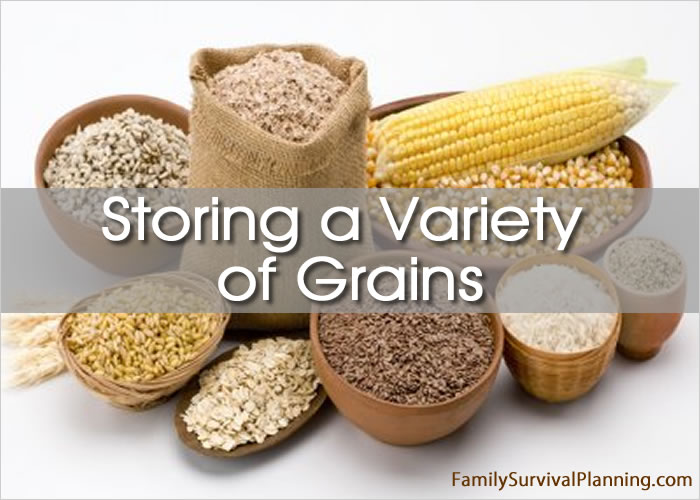
Include A Variety of Grains in Our Menus
Grains are the foundation of many menus and recipes that you feed your family on a daily basis and are considered to be a staple in a long term food storage plan.
Whole wheat is usually the primary grain most associated with food storage supplies.
But to prevent your family from getting bored eating wheat in every possible recipe, try storing grains of other varieties such as oats, brown and white rice, pearled barley, amaranth (an herb often used as a grain), flaxseed, corn, pop corn, buckwheat, millet, quinoa, rye, sorghum, spelt, and triticale. (There may be others not mentioned.)
Invest in emergency food storage now and enjoy peace of mind for the next 25 years. Don't miss out on the savings!
Grains are an excellent food storage product for several reasons:
- They have high nutritional value and protein levels (organic is more nutritious).
- Most varieties can be stored for 25+ years if packaged in airtight, oxygen-free containers and kept in a cool environment.
Should I Rotate Grains?
Yes. Why?
The best reason is to accustom your family to eating them. A sudden change in diet which includes mostly grains will upset their digestive systems. Gather recipes that include grains such as breads, cereals, and muffins.
If you do plan on storing grains to use in your daily or weekly menus, you may want to purchase them in #10 sealed cans to avoid having to use all the contents of a 5-6 gallon bucket before they are no longer palatable or nutritious.
If you choose to store them in 5-6 gallon buckets, an opened bucket will not store for 30 years. You could, however, package the grains in smaller packets, insert an O2 absorber and put several packets in a bucket.
Most grains will last about a year once opened if you are using the contents often. Keep it closed tightly in a cool, dark place, such as the pantry or the basement while using it up.
Grinding Your Own Flour
Grinding wheat seems to be a major hang-up for most people. Bite the bullet and buy a good grain mill—an electric one AND a hand grinder in case there is no electricity.
Some good choices:
Uses, Types and Shelf Life of Some Common Grains
Rolled Oats:
- Uses - Breakfast cereal, granola, cookies, filler in meat loafs or casseroles, thickener for soups/stews.
- Types - Quick rolled oats or regular rolled oats. Quick oats cook faster but regular oats or steel cut retain flavor and nutrition better.
- Storage - If unopened, optimum shelf life is up to 30 years. If opened should be used within 1 year. I recommend storing large amounts in an airtight plastic container and pulling out a smaller amount every few months for your actual usage/rotation.
Wheat:
- Uses - Wheat grass (sprouting), appetizers, desserts, breakfast cereals, crackers, brownies, tortillas, breads, pancakes, muffins, cakes, snacks, in salads, to make vegetarian meat/protein, and any other baking item you would use flour for.
- Types - Spring or winter, hard or soft, red or white. Hard varieties have higher gluten (protein) and are better for making breads. Soft varieties have lower protein and nutrients but are better for pastries, pastas, and breakfast cereals. Red wheats are typically hard and whites are typically soft. However if you prefer the flavor of one over the other you can find soft red and hard white. Experiment with different varieties in your recipes to find out what works best for you.
- Storage - If unopened, optimum shelf life is 30 years or more. If opened will last about 3 years. However, once ground into flour, wheat loses most of its nutrients within a few days so only grind small amounts at a time. You can add oxygen absorbers, bay leaves, or dry ice to help keep critters out of your wheat.
Cornmeal or Corn:
- Uses - Grits, cornbread/muffins, mush, johnnycake, hush puppies, breading on fried items.
- Types - Steel ground or stone ground. Most common is steel ground, it has husk and germ almost all removed. Loses flavor and nutrients but has a long shelf life. This is what you will find at the grocery store. Stone ground retains more of the husk and germ but is more perishable. Cornmeal can be found in white, yellow, red, and blue varieties. Yellow and white are the most common.
- Storage - If unopened, optimum shelf life is 5 years. If opened will last about 1 year. A better idea, however, is to store dehydrated whole corn and buy a grinder to make your own cornmeal. Whole corn, either freeze-dried or dehydrated, will last as long as wheat - about 25 years.
Enriched White Rice:
- Uses - Rice pudding, cereal, casseroles, side dishes.
- Types - Bleached or unbleached. Both have had their bran and germ portions removed and are “enriched” by adding back some of the lost nutrients. Bleached has been chemically bleached while unbleached goes through a natural bleaching process.
- Storage - White rice is already dehydrated when purchased from the store. It should be packaged in Mylar with oxygen absorbers and stored in any food grade bucket or container. If unopened, optimum shelf life is 30 years. If opened, it still stores well on the shelf for a very long time.
Brown Rice:
- Uses - Brown rice can be used for any dish where you would use white rice. The advantage to brown rice is that it has more flavor (even without adding anything to it), and it's definitely more nutritious.
- Types - There are no types, except maybe Basmati can be considered a type of brown rice.
- Storage - Ahhh, here's where there has been a lot of disagreement. Some say 6 months - some say years. The issue, of course, is brown rice can become rancid because it contains natural oils. I have had rancid brown rice. It is not pleasant and rancidity is definitely not good for us. I have not found any preparedness stores that carry brown rice. The very best way to store brown rice is to buy it at the grocery store and keep it in the freezer, whether it's never been opened or not to prevent rancidity.
Pearled Barley:
- Uses - Thickener in soups and stews, in sides or casseroles similar to how you would use rice.
- Types - You can buy pot barley which retains more of the nutritious germ and brand, but it has a shorter shelf life. Pearled barley is recommended for long-term food storage.
- Storage - If unopened, optimum shelf life is about 10 years. If opened, it's good for about 18 months.
Other Grain and Seed Varieties
So far I have only mentioned the most common types of grains, but there are many others that you may prefer and actually, may already have included in your daily menus. Here's a list of some grains and seeds that are not as well known:
- Amaranth
- Buckwheat
- Bulgur Wheat
- Farro
- Flax Seed
- Job's Tears
- Kamut Grain
- Millet
- Quinoa
- Rye
- Sorghum
- Spelt
- Teff
- Triticale
- Wild Rice
What about food allergies?
Yes, many people cannot enjoy any foods containing gluten, or may have other food allergies that prevent them from eating the most ubiquitous grain — wheat.
Some of the grains listed above are safe for those who are gluten intolerant, such as, quinoa, triticale, wild rice, flax seed and millet.
Michelle, one of our readers, shared this:
My son has food allergies and am wondering if I can preserve the flours I use for him in Mylar with O2 absorbers. We use these types of flours- millet, chickpea, teff, almond, coconut, white & brown rice, sorghum, potato, oat etc. Trying to find a way to include it all in our food storage....
So how do you use and store other flours?
If someone in your family has allergies to grains, yes, you can store them, but keep in mind that the shelf life of any flour, in general, is not as long as the seed, berry, kernel, or nut it comes from. Also, each of those Michelle mentioned will have varying amounts of oil, nuts in particular have quite a bit of oil in them, which makes them difficult to store long term.
So it really depends on how long you want these products to last on your shelf.
And don't forget about nut flours. These are great for gluten-free baking.
If you're planning for longer shelf life, it would be better to store the original products, like whole rice, oats, wheat, oats, etc. Then purchase a grain grinder and have fresh flours when you need them.
Electric grinders are excellent as long as you have electricity. A hand-powered backup is great for times when there might not be electricity.
Storing grains that are so basic to our daily meals is not only a good idea, but they are nutritious and healthy. So basically, most grains store very well in a cool, dry, and dark environment for many, many years. Add the grains that your family likes to your long term food storage.
You might like these:
Cooking With Food Storage: Integrate Food Storage Into Your Menus
Advanced prepper or beginner, you may be wondering how to integrate your freeze-dried, dehydrated, bottled and canned foods into your daily menus.
How to Bake Bread
Baking bread is not only delicious, but is an essential skill to learn if wheat is included in your food storage plan.
Cooking With Whole Wheat
Cooking with whole wheat will help your family get used to eating whole wheat and help you rotate your food storage.


What do you think?
I’d love to hear what you have to say in the comments.






 Valley Food Storage



As an Amazon Associate, Family Survival Planning earns a small commission from qualifying purchases.
FTC DISCLOSURE
If you make a purchase via a link on this site,
I may receive a small commission on the
transaction, at no added cost to you.
Copyright ©2007 - 2021 FamilySurvivalPlanning.com. All rights reserved.

