- HOME
- Survival Skills
- Survival Preparedness Challenge
Take the Survival
Preparedness Challenge!
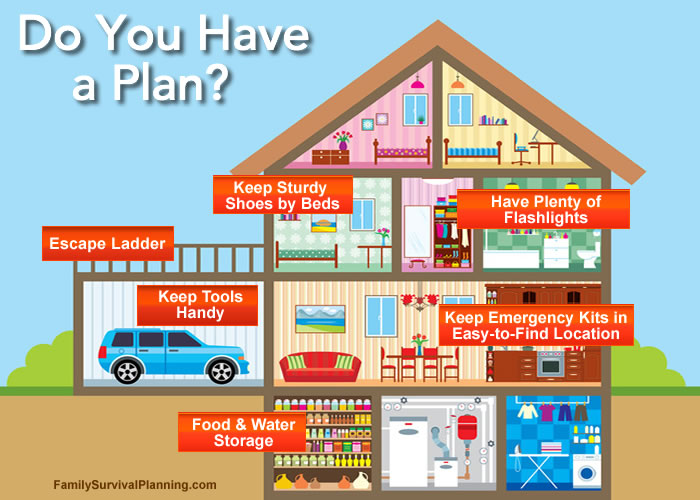
A disaster can strike with little or no warning at any moment. If you aren’t already prepared, disaster can turn into a tragedy. How will you and your family cope with it?
Invest in emergency food storage now and enjoy peace of mind for the next 25 years. Don't miss out on the savings!
Do you have a plan?
- Can your family survive for 72 hours, or even 36 or 24 hours without electricity, water, or gas?
- Have you stored enough survival supplies to provide food, water, shelter, and sanitary facilities for an extended period of time?
- Have you learned enough survival techniques to improvise if necessary?
- Do you have a plan for storms? What about earthquakes, or flooding?
- What if your community gave notice to you about a water contamination problem?
- What if there was a full-out disaster where you have no power, no water, and minimal contact with the outside world for days or even weeks at a time?
Can you live without these services?
- Water may be in short supply (or not available at all).
- Natural gas and electric power may be out for days or weeks.
- Garbage and sewage services may be interrupted.
- Telephone, Internet, cell phone and wireless communications may be overloaded or unavailable.
- Mail service may be disrupted or delayed.
- Gasoline may be in short supply and rationing may be necessary.
- Bank operations may be disrupted, limiting access to cash, ATMs or online banking.
- Grocery, drug and other retail stores may be closed or unable to restock shelves.
So here's the big question: How Ready Are You?
Today I want to challenge you to test your emergency preparedness skills; take the Survival Preparedness Challenge. You choose the time period - 24 hours, 36 hours, 72 hours - or a full week if you're in need of a significant challenge.
THE CHALLENGE
- Turn off the power and water in your home to simulate that some kind of disaster has happened. (Do not turn off your gas - it can only be turned on by the utility company. Just pretend it's off.)
- Then, all you have to do is try to perform normal daily activities.
Oh, and Here's the Catch:
Once you start the challenge, you’re not allowed to travel anywhere to gather supplies. You must use only the emergency supplies that you have on your property and in your home. Can your family handle this challenge?
Although it’s fairly simple to start, when you begin doing things like washing dishes, preparing food or even getting ready for bed, that’s when things get challenging.
Call a Family Meeting

Before you do this, of course, you’ll have to sit down and talk with your family about what you’re going to be doing and why. This step is important both because it will be better if you get everyone in the household to participate, and because the more you and your family communicate about disaster and survival preparedness, the safer everyone will be.
If you are uncertain about the impact it could have on your children, remember that they practice for earthquakes, fire, and other emergency drills at school already. Your kids will probably be excited to use the skills they've learned in school and it might even feel like a game to them.
Children Love to Pretend - Take Advantage
Take advantage of your children's love of play acting and pretend that someone in your family is hurt or injured due to the disaster. This is a great opportunity to get the whole family working together — not to mention a way to teach your kids first aid training.
Another benefit that comes from doing the challenge is the opportunity to make sure you know how to prepare your dehydrated or freeze-dried food to make it edible and delicious, as well as knowing what supplies are needed.
When my family and I tried this test a few weeks ago, we found that it was best to eat as normally as possible, and having a few "comfort" foods handy helps release the stress and tension that always accompanies a disaster.
From one of our readers:
Dave Jones from Kingston. Ontario, Canada writes:
In regards to this challenge, I started this 1 year ago, I shut off all the power to my home. I live off of my emergency supplies, canned ready-to-eat foods, plus bottled water, and have on hand a good supply of vitamins. In actual fact, it doesn't bother me living this way as I'm an avid camper and am used to living this way. Plus I have enough water for pouring down my toilet to flush it. This water can be obtained from using a rain barrel.
Lights can be from a power box charged by using a solar panel hung in my window, plus the power box can run a small TV for a few hours.
In the fall when the weather gets chilly I use my kerosene heater, but using the heater you must have a window cracked open to get fresh air once in a while.
It's not hard to live this way, you just have to prepare yourself into thinking that you have no electrical power. Also have plenty of reading material on hand and warm sleeping bags. You will survive.
What Did You Learn?
This Survival Challenge is a great way to make sure that you are prepared with supplies and tools like flashlights, radios , and anything else you may need, as well as ensuring that when a real emergency does happen, you’ll know exactly what to do to keep everyone calm and healthy.
So . . . what did you learn? Let us know in the comments below!
You might like:

What do you think?
I’d love to hear what you have to say in the comments.






 Valley Food Storage



As an Amazon Associate, Family Survival Planning earns a small commission from qualifying purchases.
FTC DISCLOSURE
If you make a purchase via a link on this site,
I may receive a small commission on the
transaction, at no added cost to you.
Copyright ©2007 - 2021 FamilySurvivalPlanning.com. All rights reserved.

