- HOME
- Food Storage Basics
- Food Storage Guidelines
Food Storage Guidelines:
Starting, Storing and Organizing
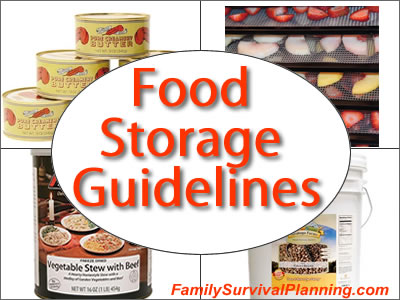
The best guideline for food storage is to store what you know your family will eat.
These food storage guidelines have been compiled to help answer any questions you might have about where to start with your storage, what you should store, and how to store each product.
Invest in emergency food storage now and enjoy peace of mind for the next 25 years. Don't miss out on the savings!
How to Inventory, Organize, and Rotate Food Storage Supplies

Do you have a little bit of this and a bit of that?
Time to take inventory.
First I decided what to store long term (grains, beans, rice, powdered milk, etc.) and what to store short term. Short term items will usually be those that are used in a 3-6 month time frame. They are usually frozen, canned or just kept on the pantry shelves.
It may be easier to divide the inventory sheet into short term and long term.
- Canned foods - I usually consider anything canned as short term food: soups, stews, home canned foods. Even though they have a shelf life of approximate 1-3 years, these are foods that I use for recipes in everyday cooking. (Bottle/can your own for the biggest savings.)
- Frozen foods - Same with frozen foods - I consider them short term storage items.
- Dehydrated foods - The shelf life depends on what food it is and how it's packaged. I have some #10 cans of dehydrated foods that have a shelf life of 25+ years. Then there are foods that I have dehydrated myself. If they are crisp-dried and vacuum packed, I consider them long term. If they are pliable, like fruit leather, dried fruits, or jerky, they are on my short term list — no matter how they are packaged. If they're not crisp-dried, they will not last long term as they have too much moisture. (Or as in the case of jerky, fat that can become rancid.)
- Bulk dried foods - These would be items like wheat, rice, beans, oats, sugar, honey, etc. All are packaged for long term storage so they will last 25+ years.
- Freeze-dried foods - Most are considered long term storage items.
Rotating Food Storage
Stocking the pantry with food used daily does take an initial investment, but it is the most economical, convenient, and self-reliant way to live. (Try this step-by-step plan to fill your pantry.) Once the pantry is stocked, it's necessary to rotate the food storage, using the older products before newer ones.
To make sure that food stored in the refrigerator, freezer, or pantry is eaten within the expiration dates, practice FIFO (First-In-First-Out). When I put away the groceries, I make sure to put the newest items behind the existing food, whether it is in the refrigerator, pantry, or food storage shelves. This saves money by reducing the amount of food that might spoil.
Leftovers should be put into clean, sanitized, shallow containers, and covered, labeled, dated, and put in the freezer (if you have one). Generally, leftovers in the refrigerator should be tossed after 48 hours.

Shelves similar to these pictured (left) make it easy to keep the older products in front while the newer products are inserted and roll down behind the older ones.
There are also patterns for DIY shelving for food storage available on the internet.
If you don't have access to this type of shelving, keep a black marking pen on the shelf and quickly write the date on the cans and packages when you put them away. At a glance, you can see what needs to be used first.
Creative Small-Space Solutions for Your Food Storage

Not everyone has the space to store years' worth of food and survival supplies.
Next to the lack of money, adequate space with the correct temperature for food storage is the greatest challenge many of us face when we decide to begin our food storage.
But it IS possible — even if you don't have the ideal storage space situation, no matter how small your home or apartment. It just takes a little creative thinking.
Rotating Long Term Food Storage: Avoiding Wasted Leftovers From an Opened Can

The advice from everywhere is to store buckets of wheat, rice, beans, powdered milk, honey . . . and more. Then we are encouraged to store a variety of foods — freeze dried, canned, dehydrated, frozen.
All of those suggestions are great advice and completely valid.
However . . .
That leaves most of us with these questions:
- If we open a bucket or #10 can, how long will the ingredients last once opened?
What Is the Shelf Life of My Food Storage?

All foods have a shelf life that is dependent on how it is prepared, how it is packaged, and how it is stored. Freeze-dried and many dehydrated foods can be stored for 25+ years.
The Real Meaning of "Shelf Life"
The shelf life of a food does not mean how long you can keep it on the shelf without having to actually eat it. A better meaning for shelf life in a preparedness context is that you have learned to store your food properly so that it will "give you life" after it has been on your shelf for a while.
The Long-Term Shelf Life Chart (on this page) is for food storage products that are to be stored for years. This would include dehydrated foods like wheat, beans, oats, powdered milk, pasta, etc. Also included would be freeze-dried foods and water.
Short-Term Shelf Life

The reason for covering the short-term shelf life is that these are foods you would keep on hand in your pantry. I call it the "pantry method". The purpose here is to have at least three months' supply of staples and recipe contents so that you can feed your family or any unexpected guests without needing to run to the grocery store. Or, if a crisis of some kind makes it impossible to get to the store or the grocery shelves are empty, you can provide nutritious meals for your famly for at least three months.
Therefore, it is important to know the shelf life so you can avoid spoilage and know when to replace foods. Also, take a look at this food storage chart for quick look-up of every day foods for short-term storage.
Safe Food Storage

Safe food storage means keeping out bugs and rodents, eliminating heat damage, and preventing rust from destroying your bulk food storage containers. It is very important to consider these possible problems when deciding where and how to store your food supplies.
Learn how to dry can dehydrated foods, how to use oxygen absorbers, and why metalized bucket liners (Mylar bags) are important for keeping food storage safe.
Why I Store Multiple Survival Foods in One Bucket

I don't know the size of your family, but there are only two of us in this household. Say, for instance, I open a #10 can of freeze dried broccoli and we eat some for dinner. How long will it take us to eat the rest of it? How long will it last once opened? We really don't want broccoli every night for dinner — we would like a variety. So what do we do?
The Calories vs Servings Controversy When Buying Food Storage Products

Are you as confused as I am over the calories vs servings controversy?
"Don't buy this 30-day food storage bucket because it has too many sugary drinks and starches."
"Don't buy this 30-day bucket because it only has 150 calories for some meals."
"Don't buy this one because you're getting plenty of servings but not even close to 2000 calories per day (the average needed by adults per day)."
I know you've read articles about this issue. Some say you shouldn't buy this or that because the calorie to serving ratio means not enough calories. Others say servings don't count — ONLY calories count.
How to Store Your Produce in a Root Cellar

Years ago, before fresh produce was available in supermarkets, root cellars were a useful way to store fruits and vegetables.
If your garden was prolific this year, you might find that a root cellar is a great way to have fresh produce for weeks or months throughout the winter.
These food storage guidelines should help you get started. As you add to your food storage, I hope you will discover how satisfying it can be to dehydrate or can your own garden grown foods, or bake your own bread.
Our goal is to become as self-sufficient as possible. Having a good supply of food, survival supplies and skills is the best insurance against any critical situation.
You might like these:
Dehydrated vs Freeze Dried Foods - Facts & Fiction
Let's explore the myths, nutritional value, costs, and serving sizes of freeze dried and dehydrated foods.
Long Term Food Storage
Long term food storage, bulk food storage is a good place to begin your emergency food storage plan.
Storing a Variety of Grains
Learn how to store a variety of grains to your long term storage.


What do you think?
I’d love to hear what you have to say in the comments.
What Other Visitors Have Said
Click below to see contributions from other visitors to this page...
I'm a cook
Hello: the information provided is very interesting and will be useful for me at work and at home. thanks





 Valley Food Storage



As an Amazon Associate, Family Survival Planning earns a small commission from qualifying purchases.
FTC DISCLOSURE
If you make a purchase via a link on this site,
I may receive a small commission on the
transaction, at no added cost to you.
Copyright ©2007 - 2021 FamilySurvivalPlanning.com. All rights reserved.
